In a matter of days, the international break will be over and both the clubs and their fans will be back to the business of real football. The latter is not another snide put-down of the international game, which in my opinion is an important counter-weight to the narrow self interest of money-driven clubs. However the best footballers and coaches in the world are competing at the top 4 or 5 leagues in Europe over a sustained 8-9 month period for some of the biggest prizes whether it be their national league or one of the UEFA titles. This is where the real action is, not on some bumpy field in San Marino vs some journeymen and part-timers.
To illustrate my point, despite a number of exciting games over the week-end between countries aspiring for the next UEFA finals (and for the next World Cup in the case of my Concacaf), the most enduring image I have of those exertions was of Wales, at home, struggling to breakdown a defensive-minded Israeli side with none other than former Chelsea journey man defender, Tal Ben Haim, looking like a top-class footballer. Last time Ben Haim played professional football in England, he was turning out for Charlton in the Championship. Cookie Coleman, the Welsh manager, who has already been chewed-up and spat out by the Premier League, had no Ozil or Cazorla to put beside Ramsay (or Ronaldo and Benzema alongside Bale). Instead he had the “great” Hal Robson-Kanu, a winger at championship-side Reading, as his sole striker huffing and puffing away for 80 plus minutes to the delight of Ben Haim and company.
That is why most of us welcome club football. There is no hiding place from the real competitive world. No place for excuses from managers that they had no players to choose, blah, blah, blah. There is also no hiding place from the data. It is remarkable how much statistics is being collected in club football, some of which is released in the public domain as is evident in websites like Squawka, Transfermkt, WhoScored etc. It is well known that infinitely more information is held in proprietary databases and only available to those with the big bucks.
In the case of our club, Arsenal, as far back as 2012 they purchased their own data analytics company, StatDNA, for £2.165m. Very little is said publicly about the company. We know it is US-based with a massive workforce in east Asia (India?) According to the Guardian, Arsenal is reluctant to divulge anything about StatDNA’s methods but quoted Ivan Gazidis with the following:
“The company is an expert in the field of sports data performance analysis, which is a rapidly developing area and one that I, and others, believe will be critical to Arsenal’s competitive position,
“The insights produced by the company are widely used across our football operations – in scouting and talent identification, in game preparation, in post-match analysis and in gaining tactical insights.”
Since then very little details have been given about the use of StaDNA in the footballing decisions at the club except for some remarks made by Arsene into the signing of Gabriel in the last January transfer window. According to the Guardian he was asked whether the decision was based on data analytics and that in response he had been coy. But he did discuss how he had monitored Gabriel by his numbers and how StatDNA had mitigated the potential risks.
“We look at interceptions, defensive errors, winning tackles – what we call tackles is committing to win the ball,”
Despite or in spite of the abundant media evidence that the football club is significantly committed to using data to support its decision making, we have the same newspapers and websites going over the top after the close of the transfer window with banner headlines declaring a virtual disaster because the club decided against signing an outfield player (apparently Jeff is the new Invisible Man). So what is the data telling us after four games.
For the first time I am trying some graphics in the hope it tells the story better than some drab tables. In this and ensuing bar charts I will be comparing the 3-year average (full seasons) for last year’s top-six clubs versus the 2015-16 season to date.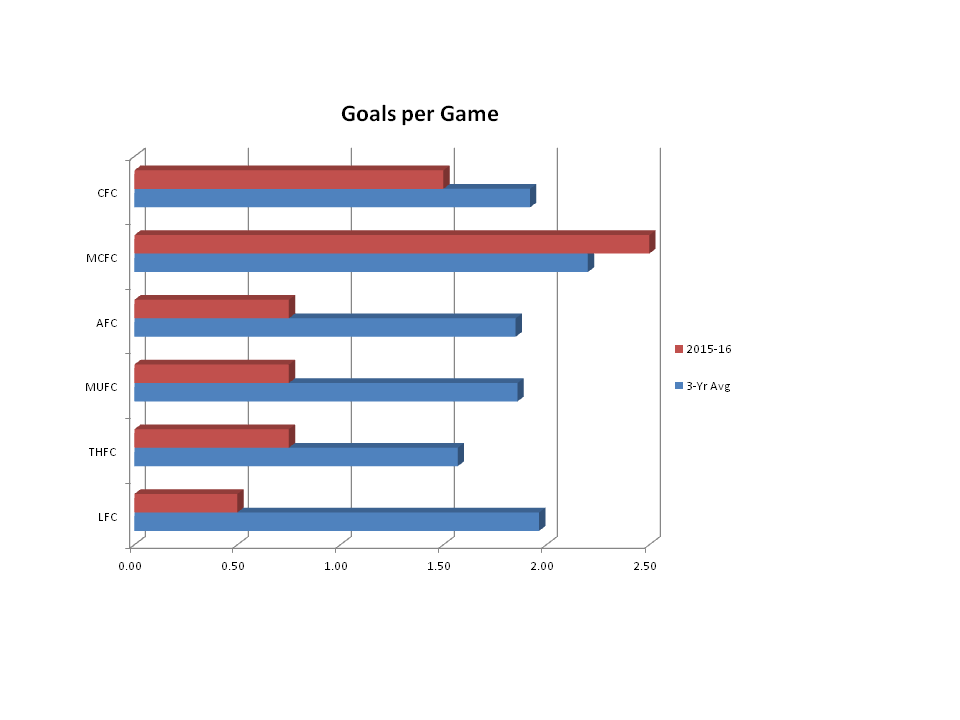
In the Goals per Game department, the information here is relatively straightforward. Apart from Man City, who are way ahead of their recent average, none of the other five clubs have hit their stride. While Arsenal shares the same cluster with United and Tottenham, it is noticeable that at this stage Liverpool is scoring 25% less goals than average. (Cue the cries for a world-class striker, not.) The safe conclusion to be drawn is that Arsenal and the other laggards will gradually get their scoring up and that City may have great difficulty sustaining their numbers given their continued reliance on Aguero for goals.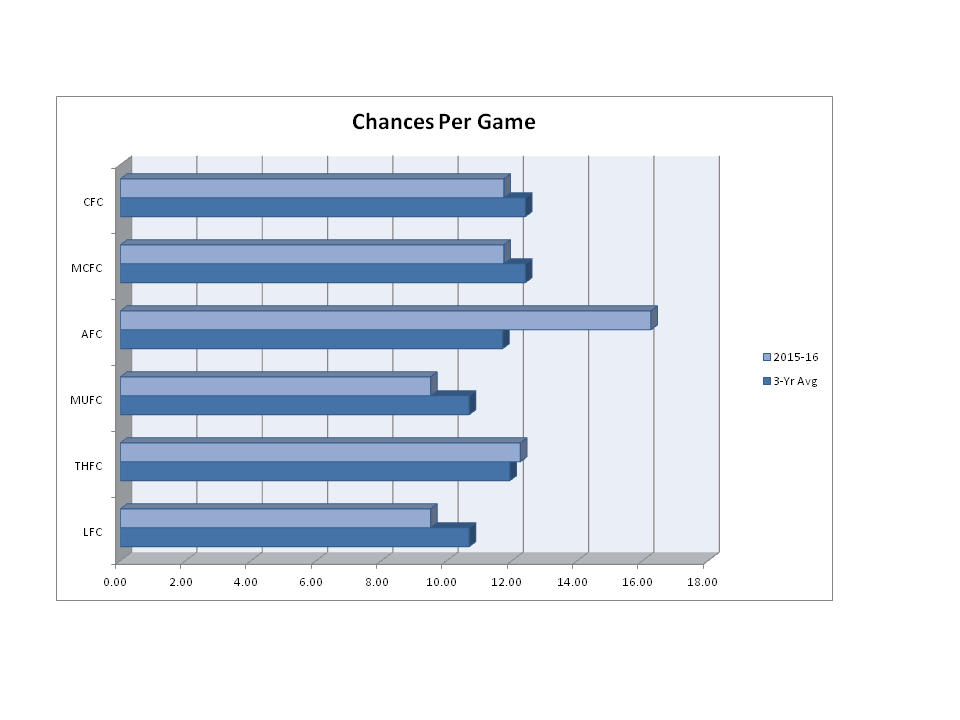
Despite most of them lagging significantly in goal scoring, last year’s top six clubs, except AFC, are relatively close to their averages in chance creation. AFC however is a clear outperformer at an insane level of 16.25 chances per game compared to 3-year average of 11.71, a 25% improvement. As with City and goal scoring, it is questionable whether this level can be sustained over the season given it is relatively the same midfield over the past 2-3 years.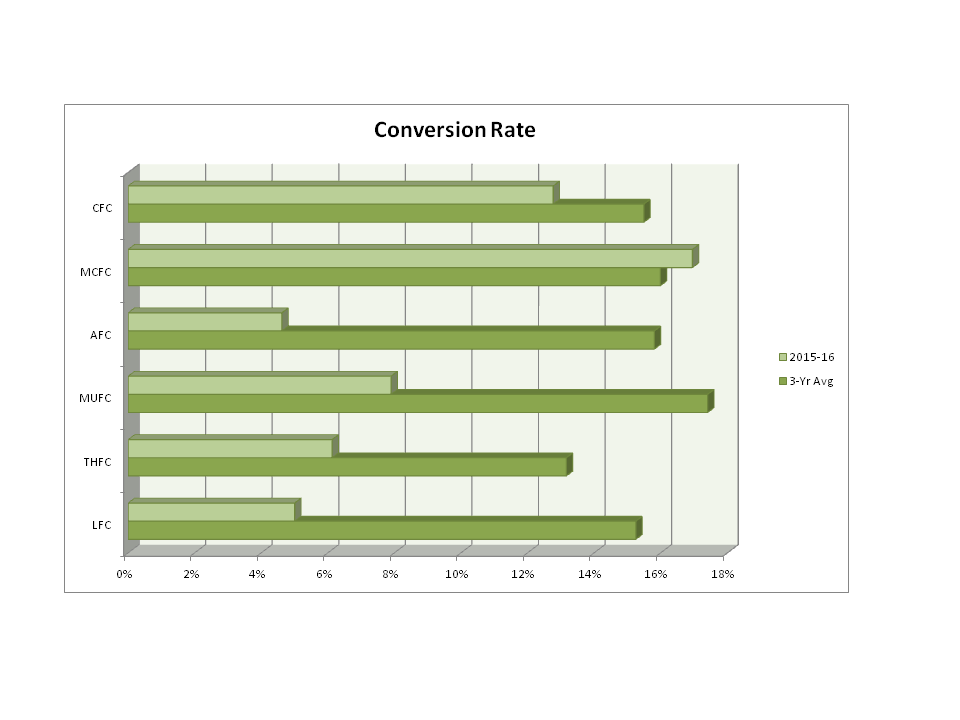
Finally, the data in relation to conversion rates among the top-6 is quite interesting. Clearly Man City is blazing holes in the old onion bag with a conversion rate of 17%. This strike rate is only 1% higher than the 3-year average of 16%. In his past two years at City Pellegrini has set up his team to score goals with 102 and 83 successively compared to 66 in Mancini’s last year. These rates are a trend not an aberration. Among the rest, all are off their 3-year average especially AFC at a puny 5%. As I have observed on this blog and elsewhere this is a statistical outlier and sooner or later, preferably the former, Arsenal will return to its average of 1.85 goals per game. It is statistically inevitable.
Is there any doubt that after getting their after 4-games statistical brief from StatDNA, Arsene and Ivan decided there was no reason to make any panic buys on deadline-day, with or without the injury to Danny Welbeck.
Unlike the media, which thrives on emotion, in the silent statistical world, there are no headlines. There are no narratives. No excuses. No hope and no despair.
Just data.