Unlike my more erudite colleagues at PA, my role is to inform and explain the sometimes boring but always unbiased data that serve as predictors of the competitive future of our club.
Due to the longevity of our great manager, we have 20 years of data covering 760 Premier League games that allow us to identify certain long term trends which are repetitive and predictable. Unlike the mainstream media and most of our colleagues who blog, podcast or tweet we do not have to resort to cheap sensationalism to make our point. A review of two very important developments will illustrate my point.
Wenger20
The celebration of Wenger’s 20 years as manager of the club was marked by a massive orgy of hyperbole and bogus platitudes by the mainstream media that must have left the manager bemused. After all, less than six months ago the self-same media, led by serial phone-hacker Piers Morgan, were eagerly fanning the flames of discontent and provoking demonstrations by fans to drive Wenger Out.
I therefore feel great empathy for our own Pedantic George when he vented in the Comments section of the blog last Saturday:
“Seeing a shower of absolute bastards, currying favour on the back of Arsene’s 20th anniversary, is turning my stomach.”
Unfortunately there is nothing that either George, I, or you the reader can do that will change the behavior of these “bastards”. It is totally consistent with my “greed and despair” paradigm to which I frequently refer. (More details here.) They are simply “sensationalizing,” preying on emotions. Notice that every member of the commercial media in England and on this side of the pond (i.e. NBC which has the Premier league broadcast rights) is doing a special on Wenger proclaiming how great he is. It makes commercial sense. Arsenal fans in particular are drawn to it in droves and those eyeballs online mean money especially for those newspapers who are bleeding readership, because the public has increasingly lost faith in them thanks to their mendacity and bias.
Yet six weeks ago, in mid-August, I did a blog showing that in the collective wisdom of nearly 40 pundits from both ESPN and BBC, Arsenal under Arsene was predicted to come 3rd in the league, in direct contradiction to the historical data. It defies reason that most journalists, pundits or bloggers within weeks, sometimes days, of declaring Wenger no longer fit for purpose, write such voluminous paeans and odes of praise to his greatness.
Unlike the mainstream media and the majority of vacillating, wavering Arsenal bloggers, we have cold hard data to justify our firmly held conviction that Arsene is not only the greatest manager this club has ever had but he is set to continue indefinitely. A contract is already in his hands and I am sure the board will be anxious as kittens until he signs. Like the bankers who demanded he agree to remain as manager for five years after moving into the new stadium, we rely on past performance, not sentiment.
“Consistency, thou art a jewel” – Shakespeare
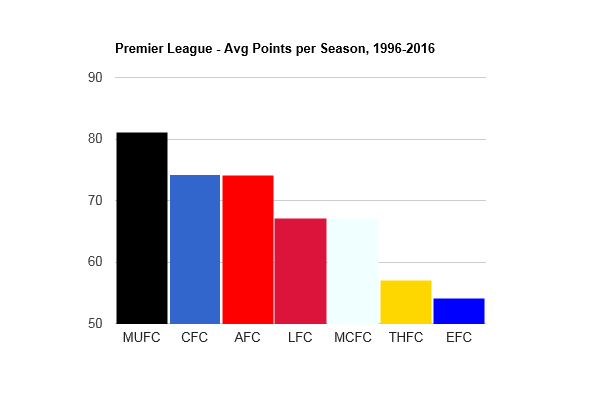
What is undeniable, from the graphic above, is that under 20 years of Arsene’s management the club has recorded the joint second highest average points per season (74) among all clubs, despite being massively outspent by United, Chelsea and City and at times, Liverpool. Despite the over one billion pounds invested in Chelsea by Abramovich in the past 12 years, the gap between them and Arsenal is negligible. (Note the graphic is generous to City whose average is calculated over 16 years by excluding the four seasons they were in the 2nd and 3rd flight of English football.) Also observable is the considerable gulf between between the Gunners and its North London rivals, in the order of 20 points. Of all his rivals Arsene is yet to overhaul or match Manchester United, a realistic prospect in the first ten years until the club decided to focus its resources on building a new and bigger stadium.This is a handy segue to doing what is now standard in my analyses which is measure Wenger’s consistency in the pre-Emirates versus the Post-Emirate years.
Pre-Emirates

The graphic and figures are crystal clear. Even though Wenger did not have the capacity to make record transfers in the magnitude of Ferguson at United, he had sufficient resources and the managerial nous to be on average only three (3) points inferior to the biggest and most successful club in England (80 vs 77 points). Despite inferior finances Arsene/Arsenal was able to capture three EPL titles including the singular honor of an Invincible, two doubles including the Invincible year and four FA cups. In contrast, Manchester City, without the financial resources of the Abu Dhabi group, had in the same ten-year span spent four years outside of the top flight generating a piddling season average of 23 points, less than one-third of Arsenal’s.
Post Emirates
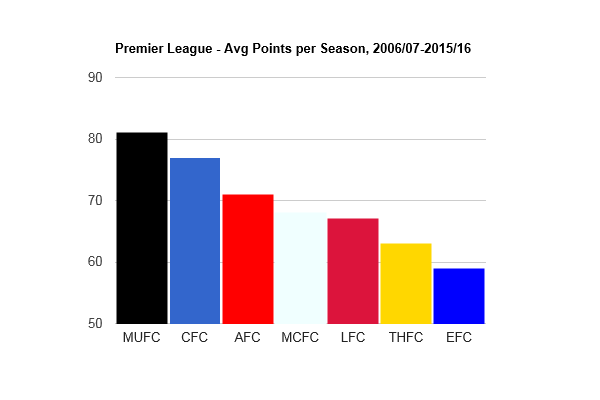
With the austerity brought on by the stadium move, as well as Chelsea and City becoming the unprecedented beneficiaries of deep-pocketed sugar-daddies, Wenger was simply unable to compete in the transfer market. Nonetheless Arsenal remained consistently among the top-three clubs in points earned with the season average dropping by six (6) to 71 points. It is notable that despite the hundreds of millions spent by Chelsea, their season average is no better than Wenger’s 77 points during his first ten years. Similarly, a big spender like City, with ten years to get a run at a financially crippled Wenger, is still three (3) points behind in current season average. Liverpool, despite the constant churn of managers, players and owners remain in-situ. That is not a comforting statistic if the scousers ever hope to catch and surpass Arsenal.
Now that Arsene/Arsenal is able to consistently spend on top-top quality players as well as patiently develop those coming through the academy, only the rabid anti-Wenger WOBs and weak-willed fans who allow themselves to become victims of groundless doom-mongering by the media, would bet against Wenger at least regaining the ground lost over the past ten-years. If he is as competitive as his brother Guy disclosed in that recent newspaper interview, Arsene will be dying to prove he has the same, if not more longevity, than his older sibling who retired at 70. How many of you, dear reader, are willing to put up a wager?
Unto Burnley
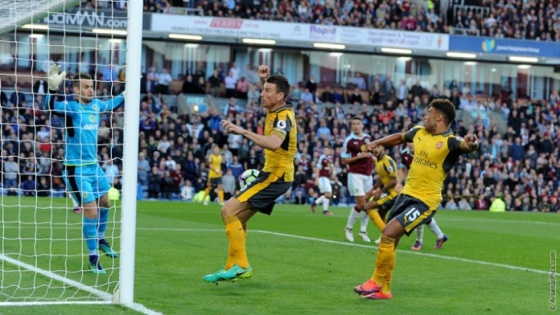
Despite the whingeing and whining in various quarters that Arsenal was not as fluent, not as free-scoring as in prior games vs Chelsea and Basel, the most important piece of data from the Burnley game is the winning streak continues. The club is now 5 wins without a loss. In contrast, the previous leader in this statistical category, Manchester City, saw their winning streak end last Sunday at 6 wins. What should hearten every Gooner is the comprehensive nature of City’s loss to Spurs, who missed a penalty by the way. Prior to this loss, the media and some Arsenal fans were noisily trumpeting Pep Guardiola as their genius manager who automatically made City presumptive champions of the EPL, a full eight months before end of season.
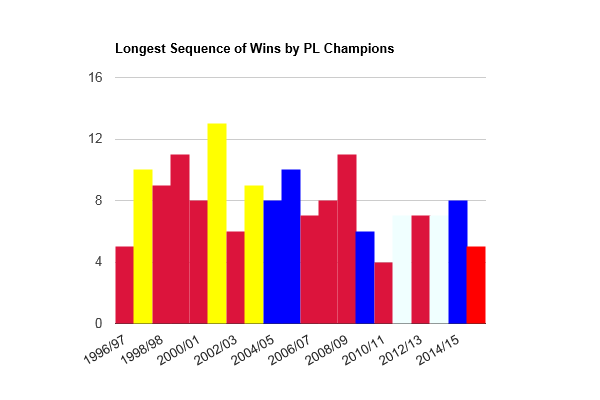
Legend: Crimson – MUFC, Yellow – AFC, Blue- CFC, Light Blue – MCFC, Red – LCFC
In my last blog I highlighted data showing that the key to Arsenal winning previous titles under Wenger was going on substantial winning streaks. The average winning sequence in those 3 championship years was 11 games, ranging from a low of 9 to a high of 13. The clear implication being that victorious Arsenal teams tend to be consistently dominant throughout a season. One may argue that the data set is too small to draw any conclusions but during the past 20 years the average longest winning streak by a PL winning club was 8 games. The maximum run was 13 games by Arsenal in 2001-02 versus a minimum of 4 games by Manchester United in 2010-11. See the graphic above.
The data in my opinion is crystal clear.
For us to confidently predict a title win, this Arsenal team must attain at least an 8 game sequence of wins. Maybe this is the streak or it will be attained later in the season.
As positively realistic fans, we will patiently wait on the data.

 Good morning Positives old and young,

 . The 2001-02 season, in particular, Arsenal went on a rampage of 13 Wins out of 16 games which was marred by only 2 draws and 1 loss. By doing so they clearly separated the men from the boys.